
Hyster Solutions for Wood and Lumber Industry Operations
Wood and lumber work is not warehouse work with longer boards. Bunks shift. Load centers (the distance from the fork face to the load’s center of gravity) stretch past the 24-inch number on the data plate. Bark, mud, and broken mill pavement chew tires. A truck that is “fine” on grocery pallets can feel light and nervous the first time it picks a wet 16-foot pack. That is why forklifts for wood and lumber have to be spec’d for the yard you actually run, not the aisle in the brochure.
Black Equipment is an authorized Hyster dealer. We help sawmills, treating plants, lumber distributors, and building-materials yards across Indiana, Kentucky, Tennessee, Arkansas, and Illinois match outdoor trucks to long loads, debris, and shipping windows that do not wait on a shop ticket.
What to take away first
- Capacity without load center is a guess. A 5,000 lb rating at 24 inches is not a 5,000 lb truck once the bunk hangs farther out or a sideshifter is on the carriage.
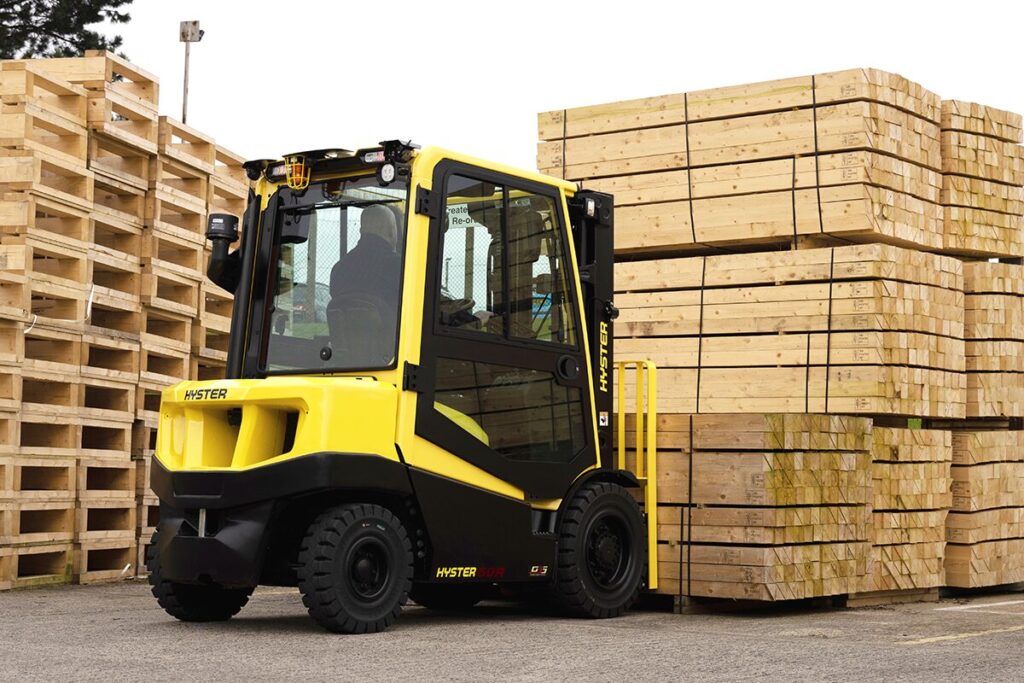
- Most lumber yards in our territory live on pneumatic ICE trucks. H40-70A and H40-60XT cover a lot of 4,000 to 7,000 lb work. Heavier packs and longer travel often move to the H80-120FT.
- When the product is no longer a standard bunk, step up. H110-155UT, H135-155FT, and H170-190FT exist for that work. High-capacity forklifts belong in extreme timber and mill jobs, not on a two-truck retail yard.
- Attachments and fork length decide the spec as much as the model name. Sideshifters, fork positioners, lumber poles, and rubber-faced forks change residual capacity. Spec them with the truck.
- Outdoor exposure is a TCO (total cost of ownership) item. Dust, heat, standing water, and shock loads show up as cooling, tire, and steer-axle cost if the truck was built for a clean dock.
- A Black Equipment yard walk is how you test terrain, peak bunk weight, and travel distance before you lock in a mast you cannot return.
What wood and lumber operations actually ask of a truck
The work spans sawmills, dry kilns, treating plants, wholesale yards, and plants that turn boards into trusses, flooring, or cabinets. The common thread is product that is long, uneven, and often unpalletized. Rain adds weight. Ice adds slip. Bark and slab wood load the cooling package.
Uneven terrain is normal, not an exception. Mill pavement breaks. Yard stone migrates. Travel paths share space with incoming trucks and load-out trailers. A missed shipping window is not a warehouse inconvenience. It is a mill schedule and a customer who already has a crew waiting.
Uptime is production. Specialized lumber handling equipment is not a luxury package. It is how you keep long loads stable and the yard moving when the weather does not cooperate.
Selecting forklifts for wood and lumber, not for a warehouse
Start with the heaviest regular bunk, the longest regular length, and the attachment, then work back to a series. Undersized or general-purpose trucks show up as tippy travel, dragged forks, and damaged product. That damage is an operating cost, not a training footnote.
What we walk most often:
- 4,000 to 7,000 lb outdoor work. H40-70A and H40-60XT for treated stock, common bunks, and mixed building materials on pneumatic tires. This is still the volume conversation at many independent yards.
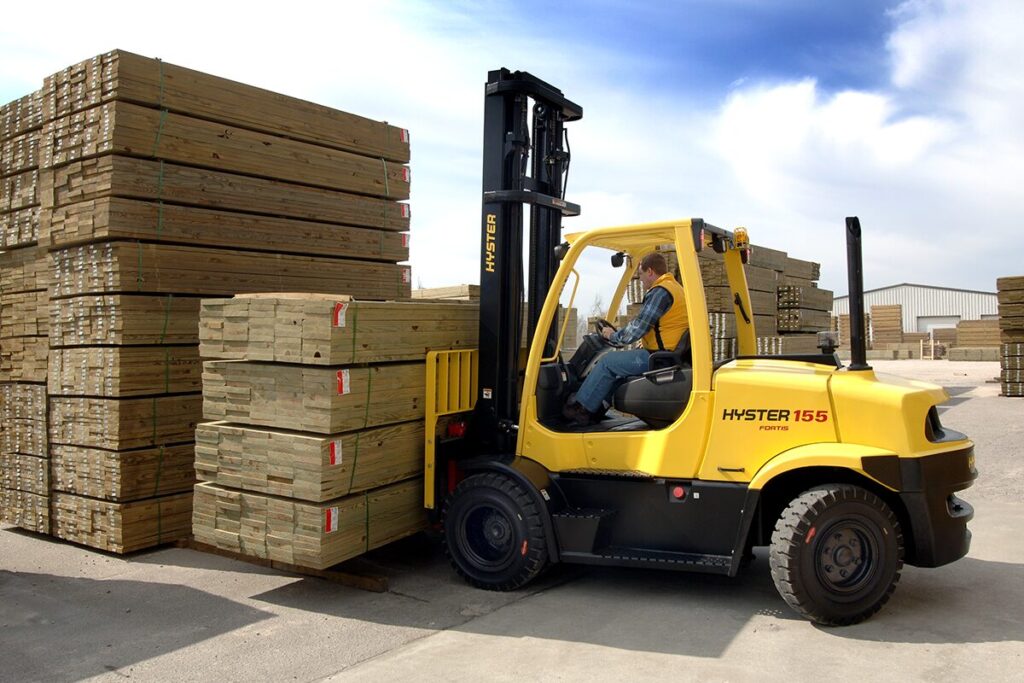
- 8,000 to 12,000 lb yard and mill travel. H80-120FT when packs get heavier and distances stretch. The H80-100UT is the simpler-service cousin in a similar band. Both show Wood as an application on our site.
- 13,500 lb and up. H110-155UT and H135-155FT when the product has left the “retail bunk” world. H170-190FT when loads step toward 17,000 to 19,000 lb.
- Above that. High-capacity pneumatic trucks for mill, timber, and extreme bunk work. They are the right tool in the right yard. They are the wrong default for a small distribution lot.
- Tire and chassis class. Outdoor lumber almost always wants IC pneumatic tire forklifts. Cushion-tire indoor trucks belong in a dry manufacturing plant, not in the stone lot. For the broader outdoor spec, see Hyster IC pneumatic tire forklifts for outdoor work. Retail home-center yards with customer traffic are a different mix; that walk is closer to our home center material handling post.
Mast, carriage, and forks are not afterthoughts. A wide-view mast helps when the load is 16 feet of board, not a pallet face. Longer forks and a sideshifter help placement on trucks. Each one reduces residual capacity. Price the real remaining capacity, not the brochure number.
Control on rough yards, not just power on paper
Continuous outdoor hours punish cooling systems, filters, and brakes. A powertrain that runs clean on a paved dock can overheat in mill dust. Traction and braking on wet stone decide whether a long bunk stays on the forks through a turn.
Precision still matters. Stacking treated packs or spotting a bunk on a trailer is not a drag-race. Operators need a truck that inches, sees fork tips, and does not fight them after six hours of vibration. Comfort is a safety item when the load is long and the path is shared.
TCO follows the environment. Cheaper iron that sits two days for a steer axle, or that destroys bunks against a trailer, is not the low-cost path. Durability is how you reduce downtime in lumber operations without adding a spare truck you cannot staff.
When heavier lumber handling equipment is the cheaper path
Buy heavier when volume has already outgrown the current truck, when yard expansion added travel, or when the product mix shifted to longer or wetter packs. Do not wait for a tip or a cracked bunk to make the case.
Hidden costs that show up in lumber yards:
- Downtime that stops a shipping door, not just one aisle.
- Product damage on finished boards, OSB, or treated stock that cannot be “restacked.”
- Near-misses with long loads in a shared yard.
- Tire and brake spend on a truck that was never meant for the surface.
ROI (return on investment) here is hours available, loads that leave intact, and a PM (preventive maintenance) interval the yard can keep. Durability is cost control when the alternative is overtime and a rental at peak rate.
Standard yard trucks versus purpose-built lumber specs
A standard pneumatic forklift and a lumber-spec truck can share a model family and still not be the same machine. The difference is usually tires, duals, fork length, carriage, load backrest, lighting, and whether the cooling package can live in bark and dust.
Decide with the work profile:
- Load variability. One SKU of 8-foot studs is a different truck than mixed 12-, 16-, and 20-foot packs the same afternoon.
- Outdoor exposure. Covered shed versus open stone lot changes cab, lights, and service intervals.
- How many yards you run. Standardization across sites cuts parts and training cost if the work is truly similar. It hurts if you force a mill truck into a small reload lot.
- Power. Most open yards in our territory still run LPG or diesel. Electric only wins if surface, weather, and charging all support it. See choosing between ICE and electric forklifts before you park a cushion electric in the mud.
Where Black Equipment fits in lumber handling
Lumber is an application walk. Brochures do not see your mud hole at the treating plant or the 3 p.m. reload spike.
What we can do:
- Map bunk weight, length, surface, and travel to a Hyster series and a residual-capacity number that includes the attachment.
- Spec forks, carriages, dual tires, and lighting with the truck, not after it lands.
- Set a PM plan for dust and hours, not for a clean indoor dock.
- Keep parts and service response tied to shipping days, not only to a standard shop calendar.
- Stay on the account. Dealer-supported lumber handling solutions are the truck plus the service that keeps it in the yard.
What we will not do is treat every wood products site as the same. A cabinet plant on slab and a treating yard on stone are different recommendations. If the work says H50A in the reload lot and H100FT at the mill, that is the recommendation.
Common questions about lumber handling equipment
These come up on yard walks. Short answers first.
Why does my 5,000 lb truck feel light with lumber?
The data plate assumes a compact load at a 24-inch load center. Long boards move that center out. A sideshifter or pole attachment moves it again. The truck is not lying. The remaining capacity is lower than the nameplate.
What size Hyster do most lumber yards in our territory run?
A large share of independent yards still land on the H40-70A or H40-60XT band. Heavier distribution and mill travel often move to the H80-120FT. Size to the heaviest regular bunk plus attachment, not to last Tuesday’s average pack.
Do I need a high-capacity truck for everyday lumber?
Usually no. High-capacity forklifts belong where packs, timber, or mill products have left the everyday bunk range. Buying that class for a two-truck retail yard adds fuel, tire, and placement cost you will feel every day.
LPG or diesel in a lumber yard?
LPG if the truck ducks under sheds and you already have a cage. Diesel if the truck lives outside, runs long hours, and the site already stores diesel. Open yards tolerate both. Enclosed dry-storage buildings do not want a diesel as a default indoor truck.
Can I use the same truck in the mill and at a home center reload?
Only if the surface, load, and pedestrian mix match. A mill yard and a customer-facing home center lot ask different things of visibility, speed, and attachments. Sharing a model family is fine. Sharing one poorly spec’d unit usually is not.
What should I inspect before a busy building season?
Tires, brakes, cooling, mast play, fork wear, and whether last year’s attachments still match this year’s lengths. Then confirm fuel supply for longer days. A PM written for indoor midweek will not cover a two-shift yard in July.
Spec the lumber truck against the bunk, not the brochure
If packs are dragging, tires are spinning, or operators slow-walk every long load, that is the signal. Treat capacity, load center, tires, and attachments as one spec. Then put service behind it.
Ready to walk the yard? Start at blackequipment.com/contact or call your local Black Equipment branch. We will compare forklifts for wood and lumber against your bunks, your ground, and the next shipping week, then build a plan you can run after the truck is delivered.
Hyster is a registered trademark of its owner. Black Equipment is an authorized Hyster dealer serving operations in Indiana, Kentucky, Tennessee, Arkansas, and Illinois. This article is general planning information, not an engineering specification or a guarantee of runtime, residual capacity, safety results, or operating cost for any single site.
OR
Click for your local branch