
Hyster IC Pneumatic Tire Forklifts for Demanding Outdoor Applications
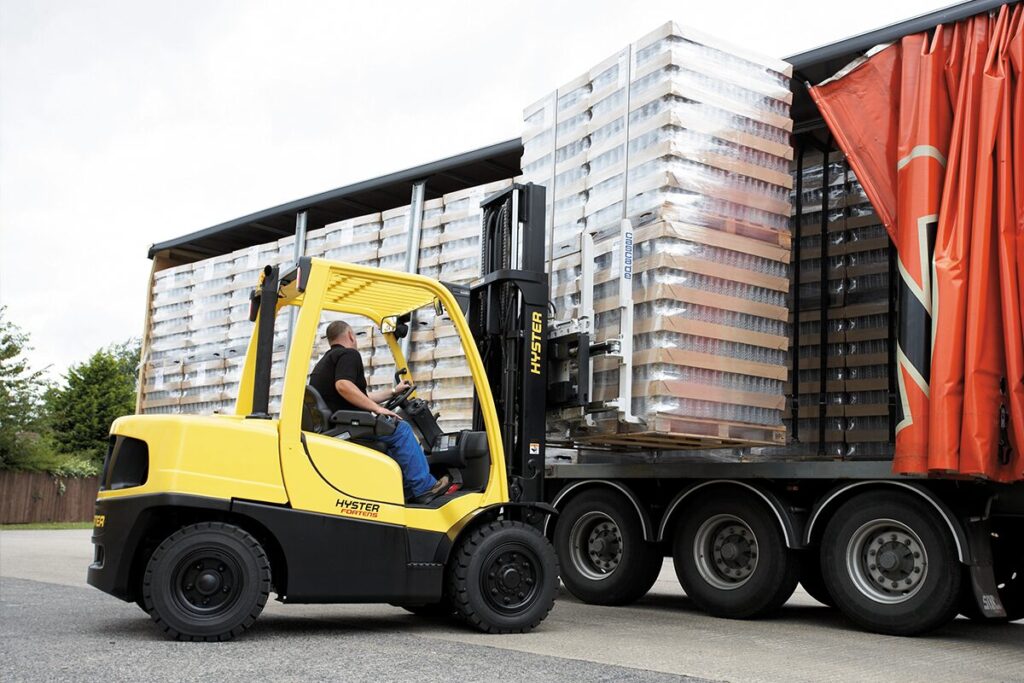
A cushion-tire warehouse truck is a poor outdoor tool. Gravel, ruts, wet docks, and long travel distances punish small solid tires and short runtimes. When the work leaves the slab, most yards in our territory still specify internal combustion pneumatic tire forklifts: LPG (liquefied petroleum gas) or diesel engines on air-filled tires that can take a beating and keep a shift moving.
Black Equipment is an authorized Hyster dealer. We help lumber yards, building-materials dealers, manufacturers, 3PLs (third-party logistics providers), and outdoor staging operations across Indiana, Kentucky, Tennessee, Arkansas, and Illinois match IC pneumatic tire forklifts to the ground they actually run on. Fuel type, capacity, and attachments should follow the duty cycle (how hard and how long the truck works in a shift), not a brochure photo.
What to take away first
- Hyster IC pneumatic tire forklifts cover a core range of about 3,000 to 19,000 lb and a high-capacity band from about 19,000 to 105,000 lb. The truck and the fuel package should be chosen together.
- Pneumatic tires (air-filled tires with a larger, more forgiving footprint) are the reason these trucks belong on gravel, packed dirt, broken asphalt, and mixed indoor-outdoor routes. Cushion tires belong on smooth indoor floors.
- LPG is the common fuel for mixed yards and sites that already have a tank cage. Diesel usually wins on long outdoor hours, heavier loads, and sites that already run diesel equipment.
- Workhorse series we spec often include the Hyster H40-70A and H40-60XT in the 4,000 to 7,000 lb band, the H80-120FT in the 8,000 to 12,000 lb band, and the H170-190FT when loads step toward 17,000 to 19,000 lb.
- High-capacity pneumatic trucks such as the Hyster H800-1050XD series exist for steel, concrete, breakbulk, and other extreme loads. See the high-capacity forklift range. They are not a default swap for a two-truck lumber dock.
- Uptime and total cost of ownership (TCO: purchase price plus fuel, maintenance, tires, downtime, and attachments over the life of the truck) matter more than the day-one sticker.
- A Black Equipment application walk is the clean way to test terrain, peak loads, and fuel logistics before you lock in a mast, tire spec, or tank farm you cannot easily reverse.
Why IC pneumatic tire forklifts belong outside
Outdoor material handling is a different job than aisle work. Surfaces change with weather. Travel distances stretch. Loads get longer, wetter, and less tidy. A truck that is happy on polished concrete can lose traction, chew through tires, and shake operators apart once it hits a yard.
Pneumatic tire lift trucks put more rubber on the ground and soak up shock that would otherwise go into the mast, steer axle, and operator. That is why lumber yards, home centers, building-materials dealers, construction staging, energy sites, and mixed manufacturing yards still lean on this class when reliability drives output.
The risk of the wrong match is not theoretical. A cushion-tire unit pulled outdoors for “just the dock apron” starts the day sliding on wet concrete. An undersized 4,000 lb truck asked to handle 6,000 lb packs of treated lumber spends the shift at the edge of its stability triangle. Either way, throughput drops and maintenance tickets rise.
Matching fuel and capacity to the job
Hyster’s IC pneumatic lineup is built around two everyday fuels and a wide capacity ladder. You are not forced into diesel because the model family is “outdoor,” and you are not forced into a 12,000 lb frame because last year’s peak load felt heavy.
Fuel first:
- LPG forklifts. Quick cylinder or tank swaps. Familiar for mixed indoor-adjacent yards where a short indoor run still happens. Fuel logistics are simple if a cage and a supplier already exist. Power stays consistent through the tank.
- Diesel forklifts. The usual pick for long outdoor hours, heavier travel, and sites that already keep diesel on the ground for other equipment. Runtime is long. Refuel is a nozzle, not a battery room. Noise and exhaust need an outdoor or well-ventilated home.
Capacity second. Hyster’s published core range for internal combustion pneumatic tire forklifts runs from 3,000 to 19,000 lb. High-capacity pneumatic forklift trucks extend that lifting power from about 19,000 lb up to 105,000 lb for heavy-duty needs. In our branches the conversations usually land here:
- 3,000 to 4,000 lb. Hyster H30-35FT and H40FTS for lighter outdoor and mixed-surface work when the load is real but not a lumber-pack problem.
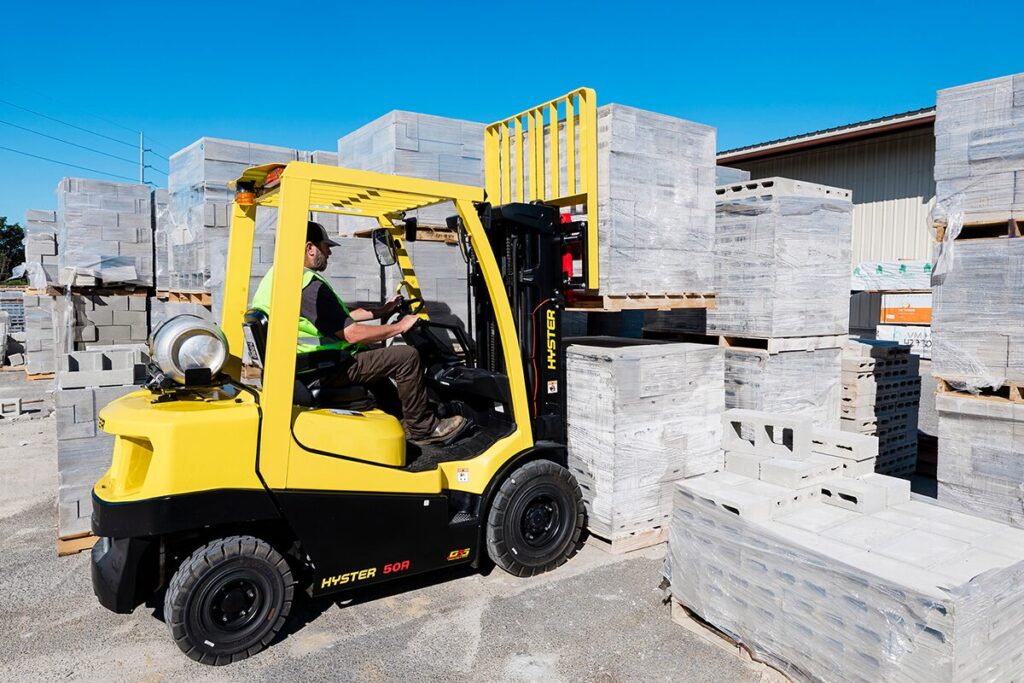
- 4,000 to 7,000 lb. Hyster H40-70A, H40-60XT, H40-70FT, and H40-70UT cover a large share of building materials, manufacturing yards, and open docks. The A Series in particular is a frequent spec when we want a configurable drivetrain without overbuying.
- 8,000 to 12,000 lb. Hyster H80-120FT and H80-100UT when packs, steel, or bulk get heavier and travel distances stretch. Variable Power Technology on the FT series lets a site lean toward fuel economy on a quiet day or peak output when the yard is stacked.
- 13,500 to 19,000 lb. Hyster H135-155FT, H110-155UT, and H170-190FT when the work is no longer a standard pallet problem.
- Above 19,000 lb. High-capacity series such as H190-280XD and, at the top of the ladder, H800-1050XD. See high-capacity forklifts. Those trucks belong in steel, concrete, ports, and other extreme-duty conversations, not on a two-shift shipping dock that mostly moves 48-by-40 pallets.
ROI (return on investment) here is mostly about not buying the wrong size twice. An undersized truck burns tires, brakes, and time. An oversized truck costs more to buy, fuel, and tire, and it is harder to place in a tight yard.
Durability and serviceability that protect uptime
Outdoor forklifts for tough applications live in dust, standing water, shock loads, and long hours. The components have to match that life. Cast steer axles, industrial masts with thicker channels, sealed connectors, and cooling systems sized for heat and dirty air are not luxury options on a yard truck. They are how you reduce downtime in outdoor operations.
Service access matters as much as iron. Hoods that open without fighting an LPG tank, floor plates that come up cleanly, and parts that are common across a series keep a PM (preventive maintenance) visit from turning into a two-day event. On series such as the H80-120FT, features like Auto Deceleration (the truck slows when the operator lifts off the accelerator) and controlled power reversal exist to save brakes and drive tires, not to decorate a spec sheet.
Operator comfort is an uptime item too. Long outdoor shifts amplify vibration, heat, and poor sightlines. A usable seat, a wide mast window, and controls that do not fight the operator are how you keep a skilled driver on the truck through a summer afternoon instead of hunting for a reason to park it.
Treat durability as a TCO advantage, not a slogan. The cheap truck that sits two days waiting on a steer-axle weld is not cheap.
Choosing the right model range for the work you actually run
Lift height, attachments, and duty cycle decide the model as much as the nameplate capacity. A 5,000 lb rating at a 24-inch load center is not the same truck once you hang a sideshifter, a rotator, or a long-load carpet pole and then send it across a rutted lot.
Walk the application before anyone prices a mast:
- Yard staging and trailer loading on packed gravel or broken asphalt. Pneumatic tires and a capacity band that covers the heaviest regular pack, not the average pack.
- Lumber, treated stock, and building materials. Long loads, uneven weight, and outdoor storage. This is still the most common H40-70A and H80-120FT conversation in our territory.
- Metals, concrete products, and bulk. Heavier capacities, attachments, and often diesel.
- Mixed indoor-outdoor routes. LPG often wins if the truck ducks inside for short runs and the site already has tanks.
- Seasonal peaks. A farm-supply or building-materials yard that doubles volume in spring does not need a year-round fleet sized only for January.
The hidden cost of the wrong truck is not only repair. It is slower cycles, extra units pressed into a job they were not sized for, and operators who stop trusting the machine. Selection is a buying guide only when it starts with terrain, peak load, travel distance, and the minutes you truly have to fuel.
A practical comparison before you buy
Indoor-oriented trucks and IC pneumatic tire forklifts are not interchangeable tools. Use the work profile, not the catalog photo.
- Surface. Smooth indoor slab points to cushion-tire electrics or cushion ICE. Gravel, dirt, broken pavement, and standing water point to pneumatic tire lift trucks.
- Travel distance and grade. Long yard runs and ramps favor IC pneumatic trucks that do not need a charger at the far end of the lot.
- Load weight and shape. Standard pallets can live on many trucks. Long, wet, or off-center loads need capacity, wheelbase, and tire footprint that match.
- Hours and fuel logistics. If the truck almost never parks, LPG or diesel with on-site fuel usually beats a battery plan that has no outdoor charging plan.
- Air and neighbors. Open yards tolerate ICE. Tight indoor production with air-quality rules usually does not. Do not drag a diesel into a closed dock and call it a fleet strategy.
Hyster positions this class as tough trucks for demanding operations. That only holds when the fleet mix matches the work. A yard that is 80 percent outdoor and 20 percent indoor should not be 80 percent cushion-tire electrics because the warehouse tour came first.
Plan the truck and the support together
Seasonal peaks, jobsite changes, and growth punish a rushed spec. Mast height, dual tires, cab or overhead guard, lights, and attachment hydraulics have lead times of their own. Choosing the configuration early is how you avoid parking a new truck for six weeks while a sideshifter ships.
Build the maintenance plan with the purchase. Outdoor hours eat filters, tires, and cooling systems. A PM schedule written for an indoor single-shift truck will not cover a two-shift lumber yard in July.
What Black Equipment can do:
- Walk the yard or jobsite and map surface, travel, peak load, and indoor versus outdoor split to a Hyster series and fuel package.
- Compare LPG and diesel against existing fuel infrastructure, noise limits, and neighbor or EHS (environment, health, and safety) constraints.
- Spec tires, masts, cabs, and attachments with the truck, not after it lands.
- Set a parts and PM plan that matches outdoor hours instead of a generic indoor interval.
- Stay on the account after commissioning. Service, rental coverage, and later fleet changes are part of the same outdoor strategy.
What we will not do is tell you there is one correct Hyster IC pneumatic tire forklift for every building-materials yard in five states. There is not. We also will not treat a heavy-duty brochure as a substitute for a load-and-surface walk. If the application says LPG on an H50A for the home-center lot and diesel on an H100FT for the mill yard, that is the recommendation.
Common questions about IC pneumatic tire forklifts
These are the questions that come up most often on yard walks in our territory. Short answers first. The rest of this post is the why.
When is diesel a better outdoor choice than LPG?
Choose diesel when the truck lives outside, runs long hours, pulls heavier loads, or the site already stores diesel for other equipment. Choose LPG when the same truck ducks inside for short runs, you already have a tank cage, or you want a faster cylinder swap instead of a fuel island.
When should I use pneumatic tires instead of cushion tires?
Use pneumatic tires (air-filled tires with a larger, more forgiving footprint) on gravel, packed dirt, broken asphalt, wet dock aprons, and mixed indoor-outdoor routes. Use cushion tires on smooth indoor slabs. Putting a cushion-tire truck on a rutted yard is how you chew up steer tires and shake the mast apart.
What capacity Hyster IC pneumatic tire forklift do I need?
Size to the heaviest regular load, the attachment, and the load center, not the average pallet. In our branches, a lot of lumber and building-materials work lands on the H40-70A or H40-60XT in the 4,000 to 7,000 lb band. Heavier packs and longer travel often move to the H80-120FT. Loads that are no longer a standard pallet problem move toward the H135-155FT or H170-190FT. Always derate for sideshifters, rotators, and long loads.
Is a 105,000 lb high-capacity truck right for a typical lumber yard?
Usually no. Hyster high-capacity pneumatic trucks, including the H800-1050XD series, belong in steel, concrete, breakbulk, ports, and other extreme-duty work. A two-truck lumber dock that mostly moves packs and treated stock is almost always better served in the core 3,000 to 19,000 lb range.
Can an electric indoor truck replace an IC pneumatic tire forklift outdoors?
Only if the surface, travel distance, weather, and charging plan say so. An electric cushion-tire truck that is perfect in the aisle can lose traction and runtime the minute it leaves the slab. For a fuller power-source comparison, see choosing between ICE and electric forklifts. If the work is truly outdoor and almost never parks, LPG or diesel with on-site fuel is still the simpler uptime plan for most yards we see.
What actually reduces downtime in outdoor operations?
The right tire and capacity first. Then a fuel plan the site can keep, a PM (preventive maintenance) interval written for dust and heat instead of a clean indoor dock, and parts access for filters, tires, and cooling. A cheaper truck that sits two days waiting on a steer axle does not reduce downtime.
Specify the outdoor truck on purpose
If the fleet is living with spinning tires, trucks that do not belong off the slab, or weekend overtime because one yard unit is always in the shop, that is the signal. Treat capacity, fuel, and tire type the same way you treat aisle width: specify them against the work, then put service behind the choice.
Ready to test the outdoor mix? Start at blackequipment.com/contact or call your local Black Equipment branch. We will walk the application, compare internal combustion pneumatic tire forklifts against the ground you run on, and build a plan you can live with after the truck is delivered.
Hyster is a registered trademark of its owner. Black Equipment is an authorized Hyster dealer serving operations in Indiana, Kentucky, Tennessee, Arkansas, and Illinois. This article is general planning information, not an engineering specification or a guarantee of runtime, emissions results, or operating cost for any single site.
OR
Click for your local branch