
The True Cost of Forklift Downtime and How Maintenance Reduces It
Intro
Every plant or warehouse manager wishes to avoid unplanned forklift downtime. When a piece of equipment is out of commission, you expect the day’s productivity to take a hit.
Even so, the actual costs of forklift downtime to a business are often severely underestimated.
In this blog post, we’ll walk you through the hidden costs of downtime, as well as how to reduce forklift downtime, so you can maximize the productivity (and profitability) of your business operations.
What Forklift Downtime Really Costs Your Operation
When a forklift breaks down, the costs extend well beyond the truck’s repair bill. Unplanned downtime results in many costs, such as rental fees for replacement equipment, lost productivity and business, and overtime pay.
In total, these costs can be significant. For example, in a recent survey, businesses in manufacturing reported an average of $250,000 lost per hour of unplanned downtime. The real costs vary depending on industry and company size. Smaller facilities may lose around $20,000 per hour of downtime, while large manufacturers could lose upwards of $1 million per hour.
Each hour of unplanned downtime can mean a significant financial loss for your business. Calculating your business’s actual downtime losses by adding up expenses from operating records can be helpful.
Measurable Financial Costs
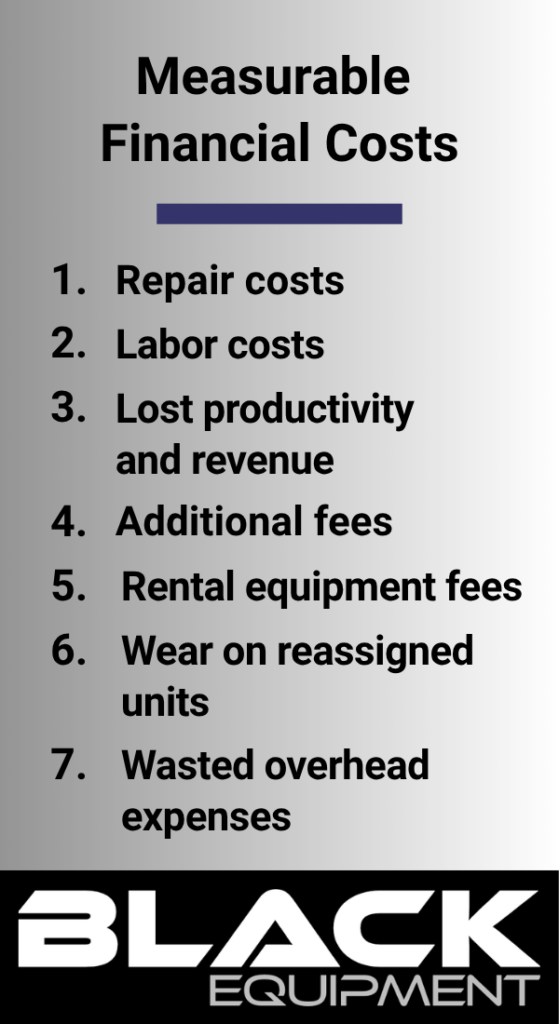
There are numerous tangible costs that may result from unplanned forklift downtime.
- Repair costs. This includes the cost of labor, parts, and travel charges if the repair couldn’t be completed on-site.
- Labor costs. Labor expenses may involve wages paid to idle operators and any overtime hours paid to employees working to catch up on production later.
- Lost productivity and revenue. Downtime can bring productivity to a halt and disrupt operations across your facility. This can result in lost revenue due to production delays and missed deadlines and deliveries.
- Expedited shipping fees or “make goods.” In addition to the fees you may pay to keep orders on schedule, you may also choose to provide discounts to customers affected by missed deadlines.
- Rental equipment fees. You may need to pay for replacement rental units if your technician determines the broken forklift cannot be repaired quickly and on-site.
- Wear on reassigned units. The additional wear on other trucks in your fleet that pick up the slack will cost your business down the road.
- Wasted overhead expenses. Fixed operating resources like water, electricity, and insurance will continue even while your employees cannot work.
Hidden & Immeasurable Consequences
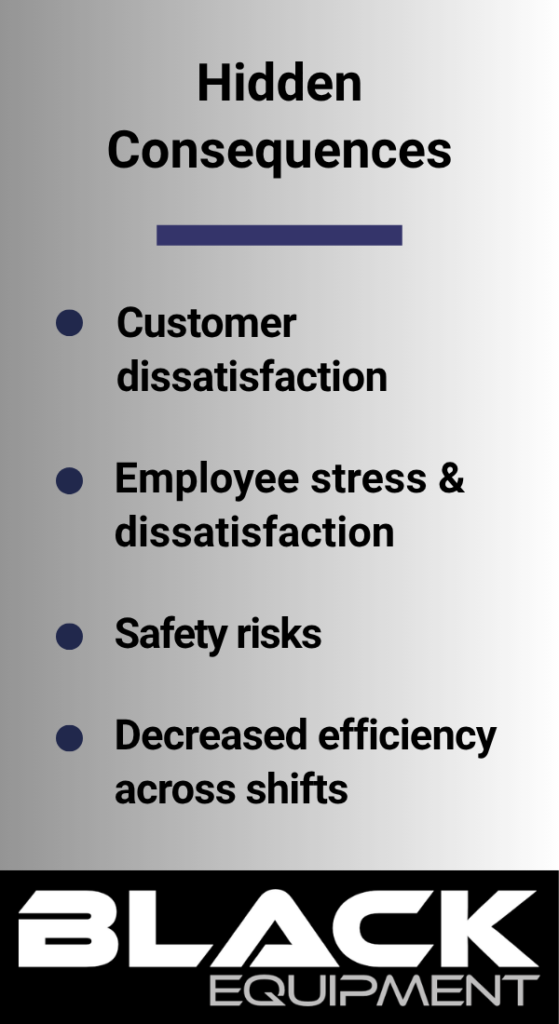
In addition to the measurable costs of downtime, your business may also suffer additional consequences that are more challenging to measure financially.
- Customer dissatisfaction. Delays or missed deadlines will likely disappoint customers and break their trust in you. This can lead to damage to your reputation and a loss of future business.
- Employee dissatisfaction and stress. Downtime can create a stressful and frustrating environment for operators, crew, and floor managers. Disruptions that happen frequently can decrease morale and strain relationships between employees.
- Safety risks. Warehouse accidents are more likely to occur when staff are rushed or fatigued. For example, workers may attempt to move heavy materials manually rather than waiting for equipment to be fixed, or operators rushing to compensate for productivity lost to downtime earlier in the day may get into an accident.
- Decreased efficiency across shifts. The disruption of downtime can have a lasting impact, as subsequent shifts will need to work to get back on schedule. Additionally, frequent breakdowns can lead to reactive firefighting and poor decision making.
The Cost of Shortcuts
While forklift downtime will cost your business, it’s worth noting that continuing to operate a forklift with equipment issues can make matters worse. Keeping a damaged forklift on the floor risks the safety of your crew, harm to product or other equipment, and further damage to the equipment which can lead to a more complex and costly repair. Be on the lookout for early signs of equipment problems and take damaged equipment off the floor immediately.
The Ripple Effect: How Downtime Impacts Your Entire Workflow
How does one forklift cause this much trouble? When a forklift breaks down unexpectedly, material handling will slow or stop entirely. That decrease in warehouse and manufacturing productivity can cause a domino effect across your entire operation.
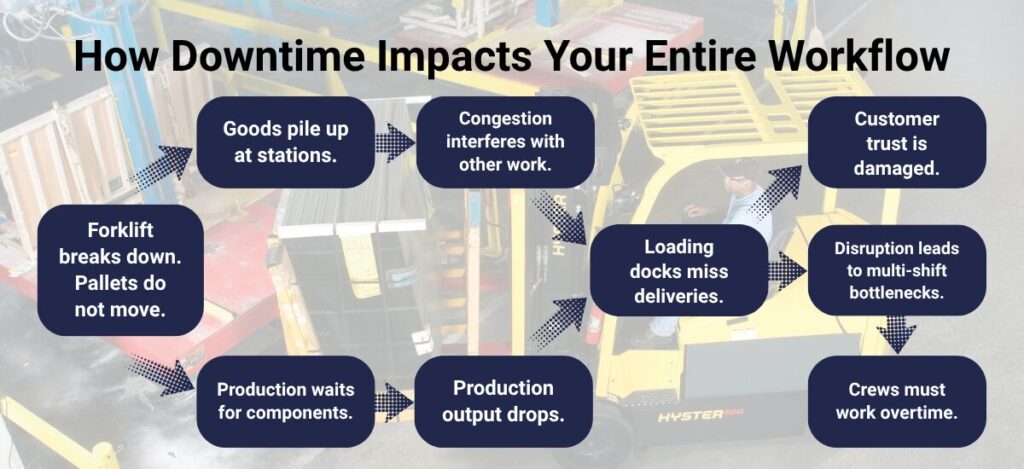
Here’s an example of what can happen in a manufacturing plant.
- Forklift breaks down.
- Pallets are not moved.
- Production lines wait idle for components. Production output drops.
- Finished goods pile up at stations, sitting in the way on the floor. This congestion can interfere with other work that would have continued.
- Loading docks miss outbound delivery windows.
- The disruption in one shift can lead to multi-shift bottlenecks. People may be required to work overtime to pick up the slack.
- The failure to fulfill orders damages customer trust.
Common Causes of Unplanned Downtime
Why does unplanned forklift downtime happen? Here are some common causes that you can take steps to avoid.
- Reactive or skipped maintenance. If you skip daily pre-shift inspections or fail to stick to your equipment’s recommended service intervals, you will likely miss equipment faults when they are easy to fix.
Pro Tip: Stick to your planned maintenance schedule to maximize your equipment’s health and performance. Conduct pre-shift inspections of your forklifts daily to spot early warning signs of issues that crop up between service intervals. - Operator error. An operator’s rough handling, rushed or careless operation, and a lack of training can all result in accidents and damage to forklifts.
Pro Tip: Offer forklift operators ongoing training by a certified inspector. Not only will training result in more capable drivers, but operators will gain the knowledge needed to determine whether their truck is suited for the task at hand. - Overused or aging equipment. Are your units up for the job? Overworking equipment will wear them down fast, and older forklifts can break down more often without adequate attention.
Pro Tip: Maintain and monitor fleet data to determine whether a forklift is ready for the day’s work, or if the truck needs additional care or reassignment to a less demanding task. - Environmental conditions. Conditions like dust, moisture, or challenging terrain speed up forklift breakdowns by contributing to part wear, electrical failures, and system contamination.
Pro Tip: Protect your equipment from the elements by regularly cleaning components like filters and hydraulic parts, changing fluids regularly, and keeping an eye on tire wear.
The ROI of a Preventative Maintenance program
The best way to reduce operating costs associated with unplanned downtime is to plan your forklift downtime.
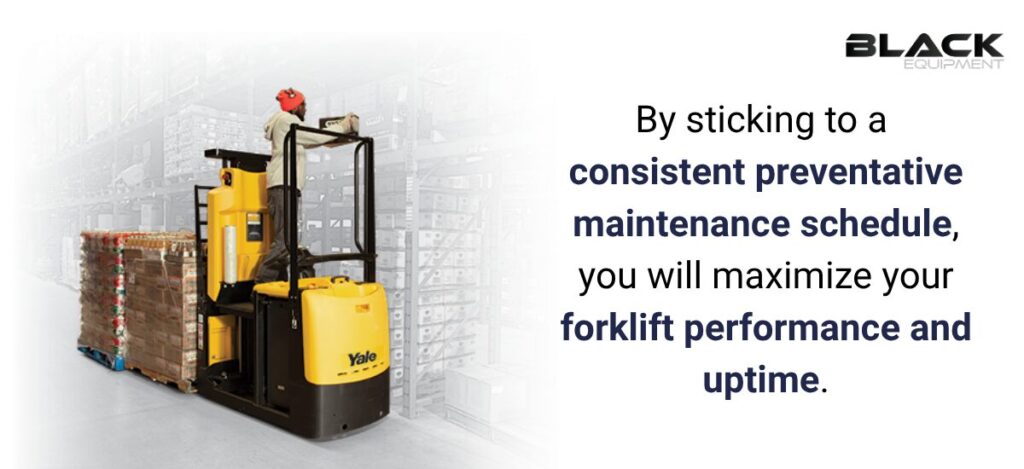
Preventative or planned forklift maintenance is a proactive approach aimed at minimizing the risk of equipment failure. By sticking to a consistent preventative maintenance schedule, you will maximize your forklift’s performance and uptime.
Fleet managers may hope to cut corners in a preventative maintenance program, as planned maintenance inherently comes with some downtime and costs. However, these are considerably lower than the downtime and costs of unplanned equipment issues.
Unlike reactive maintenance, you can work preventative maintenance around your busy production schedule. Additionally, planned maintenance for forklifts is often billed as a flat rate. This can currently range from $50 to $150 for standard equipment types and is based on the size of the equipment and the number of machines being serviced.
Benefits of preventative maintenance include:
- Cost savings and a lower total cost of ownership (TCO), thanks to a lower repair frequency and reduced need for rental units during an emergency
- Reduced downtime with fewer unexpected breakdowns
- Time savings, as crews can continue their scheduled jobs with fewer unexpected breakdowns disrupting their workflow
- Longer equipment lifespan, as issues are corrected before causing further damage and wear
- Fewer safety incidents or accidents, as preventative maintenance can catch safety issues such as faulty safety lights and malfunctioning seatbelts before they cause harm
- Less liability, thanks to fewer safety concerns
- Higher operator productivity, as equipment that is properly maintained will perform better and enable crews to complete tasks more efficiently
Impacts of Forklift Downtime FAQ
Our goal is to provide peace-of-mind to help you navigate tough decisions. Here are the answers to many common questions about unplanned forklift downtime.
- What is the cost of forklift downtime beyond repair bills? Unplanned forklift downtime can result in rental fees for replacement equipment, labor costs, lost productivity and revenue, expedited shipping fees, wear on reassigned units, and wasted overhead. Additional consequences include customer and employee dissatisfaction, safety risks, and decreased efficiency.
- How does unplanned forklift downtime affect productivity and throughput? A broken forklift can halt a warehouse’s or manufacturing plant’s ability to move materials where they need to go to meet outbound delivery windows or continue the production of goods.
- What are the most common causes of unexpected forklift downtime in a warehouse or manufacturing environment? Unplanned downtime is commonly caused by a failure to stick to equipment’s preventative maintenance schedule, skipped pre-shift inspections, operator error or training gaps, overused or aging equipment, and harmful environmental conditions.
- How can pre‑shift inspections help reduce forklift downtime? By conducting daily pre-shift inspections of your forklifts, you can detect and fix minor issues that crop up between service intervals.
- Why does preventative maintenance offer a better ROI than reactive repairs? Preventative maintenance gives the opportunity to proactively resolve minor equipment issues before they escalate into unplanned downtime, higher repair expenses, and possible safety hazards.
Final Thoughts: Maximize Your Uptime and Minimize Your Stress
Unplanned forklift downtime isn’t just a repair problem. It’s a business problem. Forklifts that break down can impact an entire day’s productivity and cost your business thousands. Meanwhile, healthy and high-performing equipment can only improve your business’s ability to thrive.
When you have confidence in your equipment to continue running smoothly, you can be confident in your operators’ productivity, your ability to fulfill orders on time, and the profitability of your operations.
Establishing a preventative forklift maintenance program with a trustworthy partner is crucial to building that confidence.
Black Equipment provides preventative maintenance and emergency repair services to maximize your fleet’s performance and uptime.
- Our certified technicians receive ongoing safety and mechanical training, so you can feel comfortable trusting your equipment with experts.
- We provide mobile on-site preventative maintenance for customers of any size fleet.
- Get timely help. If a truck does break down unexpectedly, Black Equipment provides mobile service and 24-hour Emergency Service at all our locations.
If you have any questions on proactive forklift maintenance, or want to create a plan that works, reach out to your Black Equipment branch or use our Request Service form and we’ll contact you as soon as possible.

OR
Click for your local branch