
How to Build a Manageable Forklift Maintenance Schedule for Your Fleet
Intro
When you manage multiple material handling assets, keeping up with preventive maintenance is key to maximizing fleet uptime and productivity. Falling behind schedule can lead to increased safety risks and higher operating costs.
However, creating and maintaining a forklift maintenance schedule for a forklift fleet is not easy. Managing fleet maintenance can be complex, especially when your fleet consists of diverse trucks with unique maintenance needs.
Our goal is to make this easy. In this blog post, we take you through the process of building a manageable forklift fleet maintenance schedule and provide a sample schedule and tips.
The Business Case for a Structured Maintenance Schedule
Original equipment manufacturers (OEMs) recommend forklift maintenance schedules for a reason. Failing to stick to your equipment schedule can leave you scrambling to resolve equipment faults that shouldn’t have occurred in the first place.
When you neglect to follow your fleet maintenance schedules consistently, you risk the following:
- Reactive maintenance. What could have been a minor equipment issue caught during planned preventive maintenance may escalate into disruptive failures you aren’t prepared for.
- Unexpected (and avoidable) downtime. Each hour of unplanned downtime can mean a significant financial loss for your business.
- Unnecessary equipment wear and expenses. Equipment that is not well maintained will accrue additional damage that can shorten the equipment’s lifespan and increase your total cost of ownership (TCO).
- Safety hazards. When your equipment runs with issues you aren’t aware of, you expose your crew to avoidable work hazards and your business to liability.
Adhering to an appropriate preventive maintenance schedule can extend equipment life, increase productivity, decrease your TCO, and provide peace-of-mind for fleet managers. Regular, documented inspections and services of your equipment will minimize possible safety hazards, ensure compliance with OSHA, and improve your equipment’s resale value.
Step-by-Step: How to Build Your Forklift Maintenance Schedule
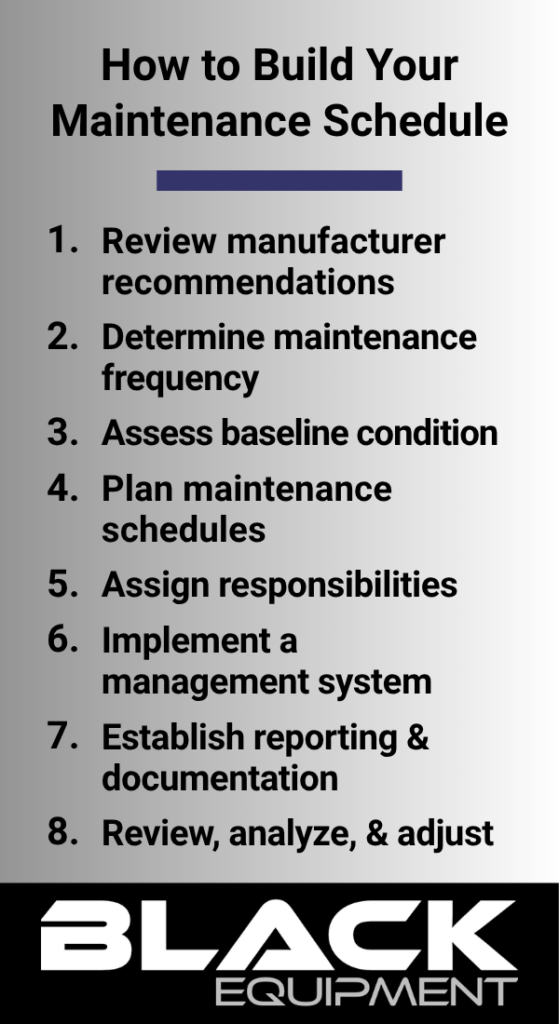
Following a fixed fleet maintenance schedule will maximize the performance and productivity of your fleet. Outlining a formal schedule will ensure no equipment misses a service and keep everyone in your company on the same page.
Follow these eight steps to build a manageable schedule that works for your business.
Step 1: Review Manufacturer Recommendations
Determine your fleet’s recommended service schedule. Refer to each forklift’s OEM manual for its standard service intervals and procedures.
Standard service intervals will be defined by the equipment’s operating hours — such as 250 hours, 500 hours, 1,000 hours, 2,000 hours — rather than following a calendar. Intervals will be unique to the type of equipment. For example, internal combustion (IC) forklifts typically need service every 250-300 hours, while electric forklifts will need service every 500 hours.
Pro Tip: Adhering to OEM guidelines will not only help you meet each forklift’s unique needs, but also help equipment uphold warranties.
Step 2: Determine Maintenance Frequency
How often should you be taking care of preventive maintenance for your equipment?
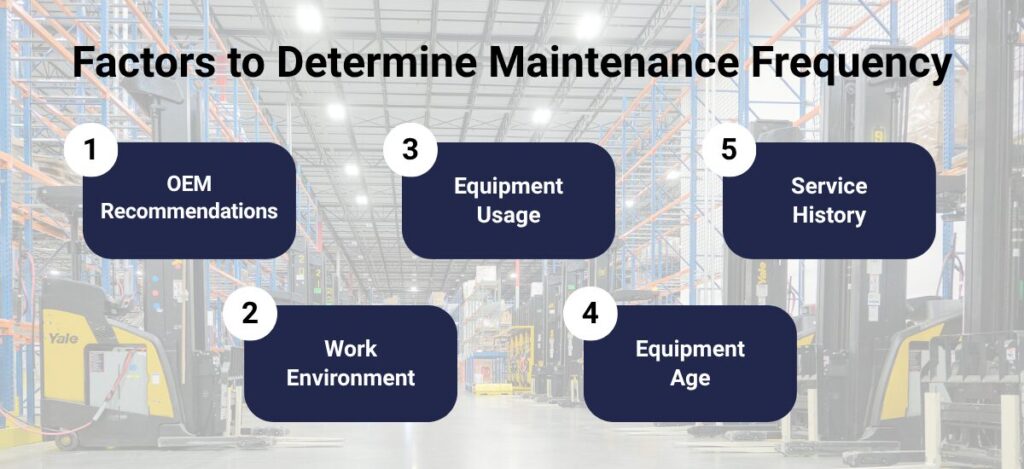
Now that you know the OEM service interval recommendations for your equipment, you will also want to consider additional factors.
- Work environment. Does the forklift operate in dusty, harsh conditions, extreme temperatures, or exposure to contaminants? These machines will require more frequent services.
- Equipment usage. The types of jobs the machine performs and the way operators use the equipment will have an effect. This includes the attachments used and how often operators utilize the forklift’s full lift capacity.
- Equipment age. Older equipment may need to be serviced more regularly, as they may accumulate more wear on moving parts.
- Service history. If a specific component on a machine repeatedly requires repairs, plan to monitor that item more frequently.
Pro Tip: Be ready to adjust a forklift’s service schedule depending on the season. For example, you may determine one diesel forklift requires its 250-hour service every six weeks. However, it may benefit from a service after just four weeks during peak season.
Step 3: Assess Baseline Condition
Before you plan your upcoming maintenance needs, you’ll need to understand what those needs are. Confirm your fleet’s current health and performance first, so you don’t overlook any existing repair priorities. Establish a forklift’s baseline condition by:
- Reviewing the truck’s maintenance history, including tasks performed at its most recent service
- Conducting a comprehensive inspection if necessary
- Identifying safety-critical components, such as parts that directly affect braking, hydraulics, steering, lifting, forks, and more
- Requesting a service to repair any priority safety issues
Step 4: Plan Maintenance Schedules and Checklists
Now you can map out your fleet’s maintenance services on your calendar. This should include daily, weekly, monthly, and quarterly tasks.
The best schedule will be designed to serve the unique needs of your facility and fleet. A one-size-fits-all approach won’t work if you manage a mixed-fleet with specialized equipment and varying service frequencies. You’ll likely want to create a tiered schedule system that groups trucks according to:
- Type of forklift
- Usage frequency and duration
- Work environment
- Duty cycle
Organize your trucks into batches according to these factors and apply a unique schedule per batch, rather than using a single schedule for all.
Pro Tip: Operators should inspect their vehicles daily and diligently. OSHA standard 29 CFR 1910.178 requires daily pre-shift equipment checks before operating any vehicle. By taking the time to carefully inspect your forklift each day, you can catch issues that arise between services and prevent safety hazards.
Step 5: Assign Responsibilities
Training your staff on the new fleet maintenance schedule is essential to seeing it carried out properly and consistently.
This instruction should include clearly defining the responsibilities of operators and any in-house technicians and ensuring they know how to perform each task. You’ll also want to plan and communicate who oversees scheduling preventive maintenance with a qualified fleet maintenance partner.
Step 6: Implement a Maintenance Management System
Integrate technology to streamline scheduling processes and prevent any service or repair from falling through the cracks. Establish a system, such as a Computerized Maintenance Management System (CMMS), to help with management and tracking.
A CMMS platform tracks the scheduling of services, completion of maintenance, and the maintenance that needs to be done. Sophisticated CMMS platforms can help with automation, service reminders, data tracking, and issue reporting.
Step 7: Establish Reporting & Documentation Procedures
Utilizing a proper reporting and documentation system is essential for catching equipment issues, OSHA compliance, and continually improving your fleet maintenance strategy. Your forklift operators and technicians should be trained in your reporting procedures, as they have the primary opportunity to spot and report issues before they progress.
Be sure to maintain complete records of all forklift services, defects, tag-outs, repairs, and technician recommendations.
Step 8: Review, Analyze, and Adjust
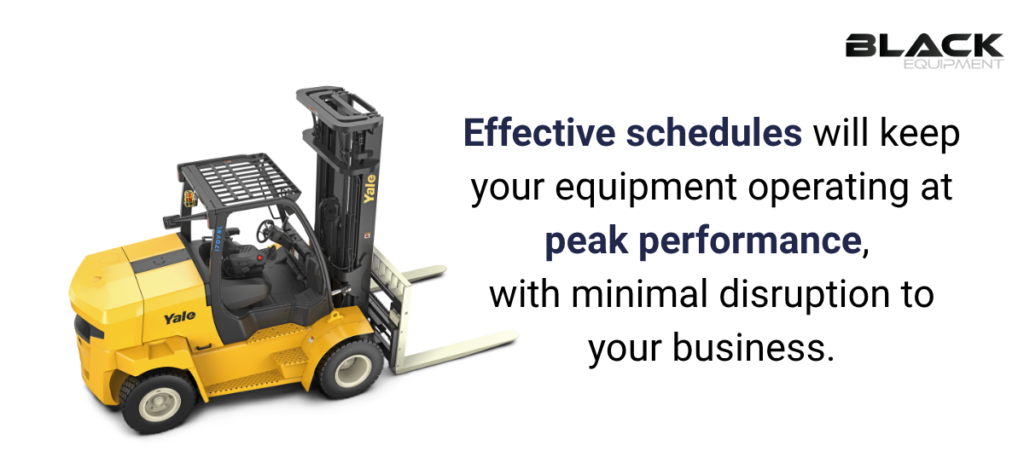
The most effective fleet maintenance schedule will be one that keeps your equipment operating at peak performance, with services occurring with minimal disruption to your business. To achieve that, you may need to continually review, tweak, and improve your schedule over time.
Conduct a quarterly review of maintenance data and schedules to monitor their effectiveness and benefits to your fleet. Be prepared to adjust based on wear patterns, changes to your fleet, or new projects or product lines.
Pro Tip: You can monitor your fleet maintenance data all in one place with Black Equipment’s Premier Fleet. Oversee historical data for every forklift, including completed service tasks, repair costs, onsite inventory levels, as well as insights into equipment utilization, availability, charging, TCO, or maintenance. Such data points can transform the way you optimize your fleet management strategy.
Sample Forklift Maintenance Schedule
Below is a sample maintenance schedule for IC or electric forklifts. This is intended to serve as an example and provide a general idea of maintenance needs. Please follow manufacturer guidelines or consult with your technician regarding your specific forklift maintenance needs.
| Service Interval* | Service Checklist |
| 250 Hours Periodic Maintenance** | • Lubricate chassis and mast components. • Change engine fluids and filters. • Blow out and inspect the brakes. • Check the hydraulic system and mast. • Check belts, hoses, the drive train, steering, and electrical system. • Inspect tires for damage and wear. Inspect attachments (if applicable). • Confirm OEM manual is on the truck and accessible. • Ensure equipment data plate is on the truck with attachments and capacities |
| 500 Hours Periodic Maintenance | • Inspect hydraulic system and mast, battery cables and terminals, tilt cylinder, and brakes. • Clean debris from radiator and oil cooler. • Change engine fluids and filters. • Lubricate chassis, mast components, tilt cylinder pins and components, brake pedal linkage and master cylinder pin. |
| 1000 Hours Periodic Maintenance | • Inspect integral sideshift carriage for wear. • Check engine electrical connectors, intake and exhaust valves, and drive shaft. • Change fuel filter and fuel water separator, axle oils, cab air filter. • Lubricate hydraulic controls, accelerator pedal linkage, cab and hood hinges and latches, seat slides, steel axle king pin, LPG tank bracket latch, and mast. • Change engine oil and filter if necessary |
| 2000 Hours Periodic Maintenance | • Inspect integral sideshift carriage and EGR cooling, pipe, and connections for wear. • Check service brake thickness. • Check grease on brake axle and steer axle wheel bearings. • Change hydraulic oil filter and tank breather; air cleaner; powershift transmission oil, filter, and breather; hydrostatic transmission oil and filter. • Drain and fill brake axle fluids |
*Actual service intervals will depend on equipment work environment and usage.
**IC Forklift only – Electric forklifts do not require service at 250 hours.
Building a Forklift Maintenance Schedule FAQ
Our goal is to provide peace-of-mind to help you navigate tough decisions. Here are the answers to many common questions about building a manageable forklift maintenance schedule.
- How often should my forklifts receive preventive maintenance based on OEM recommendations? Standard service intervals will be defined by the equipment’s operating hours. Typical intervals are 250 hours, 500 hours, 1,000 hours, 2,000 hours. Refer to your equipment’s OEM manual for specific intervals.
- What factors influence how frequently a forklift in my fleet needs to be serviced? In addition to OEM service intervals, consider your forklift’s work environment, equipment usage, age, and repair history.
- How do I determine the baseline condition of a forklift before building its maintenance schedule? Review your forklift’s maintenance history, conduct a complete inspection if warranted, and identify any safety issues.
- How should I organize maintenance schedules for a mixed fleet with different truck types and duty cycles? Develop multiple schedules for your forklifts, according to their equipment type, usage frequency and duration, work environment, and duty cycle.
- What responsibilities should operators and in‑house technicians have in a forklift maintenance program? Operators will be responsible for conducting daily pre-shift inspections of their equipment. Certified in-house technicians may be assigned planned maintenance services. Additionally, designate who will oversee scheduling maintenance with a third-party service provider.
- What reporting and documentation procedures are necessary for OSHA compliance? Maintain complete records of all forklift inspections, services, defects, tag-outs, repairs, and technician recommendations.
Final Thoughts: Make It Easier with a Data-Driven Fleet Management Partner
Managing fleet maintenance schedules can seem daunting at first. However, by working through the above steps, you can develop an effective preventive maintenance schedule that works for your fleet.
With a solid plan in place, you can proactively address equipment issues before they escalate and cost your business time and money.
At Black Equipment, we hope to make preventive maintenance simple for you. Consider setting up a Guaranteed Maintenance contract with Black Equipment now so you’re prepared. When you partner with Black Equipment for your fleet maintenance needs, you can expect:
- Comprehensive maintenance services at a flat monthly rate, covering preventive maintenance and emergency repair service in all cases except for abuse and tires.
- 100% service transparency and peace-of-mind with Premier Fleet
- Mobile service and mobile tire and battery/charger support
- Certified, expert technicians who receive ongoing safety and mechanical training
If you have any questions about constructing a forklift fleet maintenance schedule or wish to work with an experienced maintenance partner, reach out to your Black Equipment branch or use our Request Service form and we’ll contact you as soon as possible.
OR
Click for your local branch