
Yale Power Sources: Choosing the Right Energy Solution for Material Handling
The energy package under a lift truck used to be a footnote. It is not anymore. Shift length, charging space, fuel logistics, and sustainability targets now sit on the same sheet as capacity and mast height. The wrong forklift power option can idle a dock. The right one disappears into the work.
Black Equipment is an authorized Yale dealer. We help warehouses, 3PLs (third-party logistics providers), manufacturers, and outdoor yards across Indiana, Kentucky, Tennessee, Arkansas, and Illinois specify Yale power sources against real shift work. No single energy solution wins every application. Start with the duty cycle (how hard and how long the truck works in a shift), then look at the building and the next few years of growth.
What to take away first
- Yale power sources cover lead-acid batteries, lithium-ion batteries, thin plate pure lead (TPPL) batteries, internal combustion engines (ICE), and hydrogen fuel cells. The truck and the energy package should be chosen together.
- Uptime, charging or fueling time, and total cost of ownership (TCO: purchase price plus energy, maintenance, downtime, and infrastructure over the life of the truck) matter more than the sticker on day one.
- Lead-acid still works where a charging room and battery-swap routine already exist. Lithium-ion is the usual next step when opportunity charging (plugging in during breaks instead of swapping batteries) can replace that room.
- ICE, often LPG (liquefied petroleum gas) in our territory, remains a strong outdoor and mixed-yard answer when the grid, runtime, or weather argues against a battery.
- Fuel cell forklifts can make sense for high-hour fleets that can support hydrogen infrastructure. They are not a default swap for a single-shift warehouse.
- Yale Power Key™ lets many Class 1, 2, and 3 electrics switch among lead-acid, TPPL, and lithium-ion without extra hardware. That keeps a fleet from getting locked to one battery type.
- A Black Equipment power assessment is the clean way to test a spec before you buy infrastructure you cannot move.
Why power source selection matters more than ever
Throughput targets keep rising. Labor is tighter. Many sites now run longer days without adding a full extra shift of people. That combination makes energy reliability a scheduling problem, not just a maintenance one.
A mismatched power source shows up in familiar ways. A lead-acid fleet with no spare batteries cannot cover a late outbound wave. A lithium-ion truck with no charger capacity sits through lunch. An ICE unit that should live in the yard gets pulled indoors and fights air-quality rules it was never meant to meet.
Power choice also locks in infrastructure. Charging rooms, hydrogen dispensers, LPG cages, and electrical service upgrades are not items you casually reverse next year. Treat the energy decision as fleet strategy, not a line-item swap.
The range of Yale power source options
Yale’s power lineup is built so the same family of trucks can take different energy packages. You are not forced into one technology because the model number says so.
The options we walk most often:
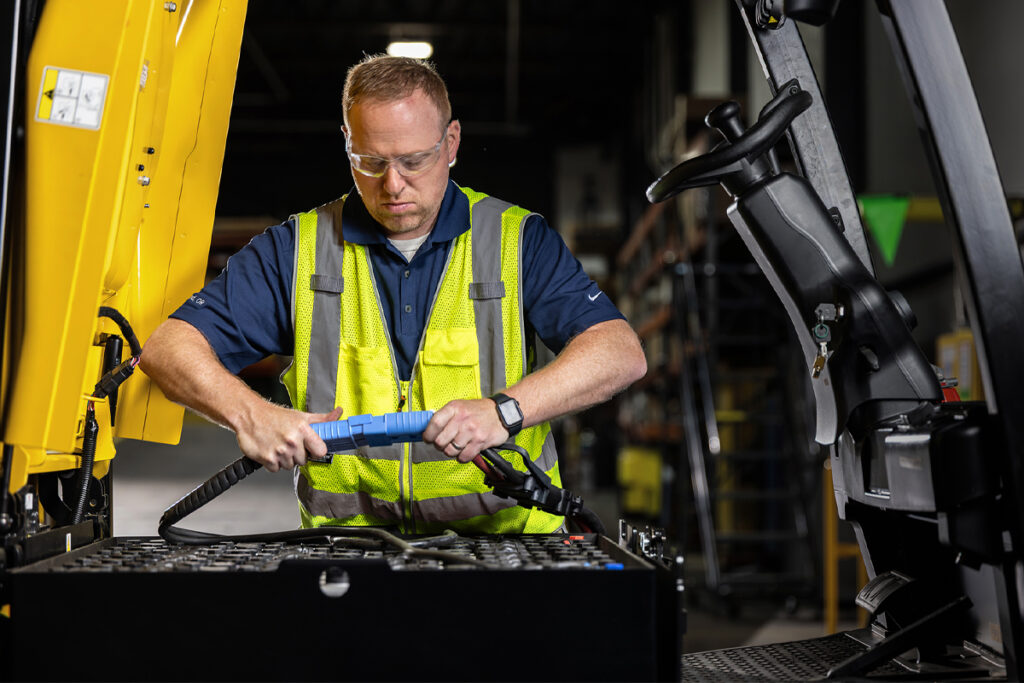
- Lead-acid forklift batteries. Lowest acquisition cost of the electric group. Proven. They need watering, equalization (a controlled overcharge that balances the cells), cool-down time, and usually a dedicated charging room. Multi-shift sites typically swap batteries rather than wait on a charge.
- Thin plate pure lead (TPPL). A sealed lead battery that supports opportunity charging and skips much of the watering routine. It often lands between flooded lead-acid and lithium-ion on first cost.
- Lithium-ion forklift batteries. Yale’s lithium-ion packages use lithium iron phosphate (LFP) chemistry, which is more heat-stable than some other lithium types. They are maintenance-free, hold consistent power through the shift, take opportunity charges, and can reach a full charge in as little as one to two hours depending on the pack and charger. There is no off-gassing (hydrogen released during a typical lead-acid charge), which changes how you think about indoor air and food-grade space.
- Integrated lithium-ion trucks. Some Yale series ship with the pack built in rather than dropped into a battery box. In our conversations those often include indoor units such as ERC-VGL in the 5,000 to 6,000 lb range and heavier indoor-outdoor work on ERP-VNL in the 15,500 to 19,000 lb range with a 350-volt pack.
- Internal combustion. LPG, diesel, and gasoline still earn their keep outdoors and in mixed yards. Yale GP-VX pneumatic trucks in the 4,000 to 8,000 lb band remain a common request in lumber, building materials, and open docks. No grid. Consistent power. Fuel logistics instead of chargers.
- Hydrogen fuel cell forklifts. A fuel cell turns hydrogen into electricity on the truck. Refuel time is often around three minutes. Power stays consistent to the end of the tank. The tradeoff is site infrastructure: storage, dispensers, and a hydrogen supply contract. That package fits large, high-hour fleets better than a two-truck shipping dock.
Yale Power Key™ is the flexibility layer on many electric models. The truck talks to a qualified battery over the CANbus (the vehicle’s internal communication network). An operator or technician can switch the truck among lead-acid, TPPL, and lithium-ion modes from the display, without bolting on extra adapters. That helps mixed fleets, multi-site companies, and anyone planning a staged move off flooded batteries.
Matching power solutions to the work you actually run
Spec sheets do not run your building. Duty cycle, shift length, and the minutes you truly have to charge or fuel do.
Walk the application before anyone prices a charger pad:
- Single-shift indoor work with a lunch and an end-of-day window often still supports lead-acid if the charging room is already paid for and staffed.
- Two- and three-shift docks usually force a choice: extra lead-acid packs and a swap routine, or lithium-ion with opportunity charging at breaks.
- Tight warehouses and 3PL floors often point to Yale ERC-VG cushion-tire sit-downs in the 4,500 to 7,000 lb range, or ESC three-wheel stand-up electrics in the 3,000 to 4,000 lb range. Those are natural lithium-ion or Power Key conversations when charging space is scarce.
- Narrow-aisle and order-picking work (Yale OS, SS, or FS series around 3,000 lb) lives and dies on battery availability. A dead picker in a narrow aisle stops more than one person.
- Outdoor yards, ruts, weather, and long travel distances still favor ICE unless you have already budgeted high-voltage lithium-ion and the chargers to match, such as the ERP-VNL class for heavier indoor-outdoor electric work.
- Cold storage, food, and beverage sites often want sealed batteries and no charging-room fumes. Lithium-ion and TPPL tend to lead that discussion.
- Fuel cells belong in the conversation when the fleet is large enough to justify hydrogen storage and the trucks almost never park long enough for a charge.
Then check whether the site can support that choice. Lead-acid needs ventilation, washdown, and spare packs. Lithium-ion needs electrical service, operators who actually plug in, and battery and charger support. ICE needs fuel storage. Fuel cells need a hydrogen partner. If those pieces are missing, the truck will not save the schedule.
Total cost of ownership and a longer energy strategy
Purchase price is the loud number. It is rarely the expensive one.
TCO for material handling energy solutions usually includes:
- Energy or fuel cost per hour, not just per gallon or per kilowatt-hour. A cheaper kilowatt-hour that requires two extra battery swaps can still lose.
- Maintenance labor. Watering, equalization, and battery-room cleaning are real hours. Drop those tasks and the cost often moves to chargers, fuel contracts, or training instead of disappearing.
- Downtime. A truck waiting on a charge, a swap, or a fuel delivery is a scheduling cost. It does not show up on the quote.
- Space. Charging rooms and spare-battery racks occupy floor that could hold racking. Opportunity charging can give that floor back.
- Change. Fleet growth, a second shift, or a new SKU mix can make today’s “cheap” lead-acid plan expensive in year three if you have to add packs and chargers in a hurry.
In our branches, LPG and battery still split a lot of the work about evenly. Lithium-ion is the transition story on the electric side. Lead-acid stays in the mix where the room and the routine already work. None of those is automatically the low-cost answer. Run hours, labor, and infrastructure against a three- to five-year plan, not against this quarter’s capex (capital expenditure) line alone.
A good energy strategy also leaves an exit. Power Key-enabled trucks and lithium-ion-ready frames keep resale and redeployment open if the site changes. Buying a one-way infrastructure bet because a brochure looked clean is how fleets get stuck.
Sustainability goals without pretending the truck does all the work
Energy choice is one of the few fleet decisions that shows up on both the operations scorecard and the sustainability report. Electric power sources produce no tailpipe emissions at the truck. That helps indoor air and can support site-level carbon targets, especially when the building’s electricity is getting cleaner. Sealed packs also retire watering and acid handling, which many EHS (environment, health, and safety) teams are glad to give up.
That is not a free pass. An oversized lithium-ion pack that never gets plugged in is not a sustainability win. Neither is a fuel cell project with no reliable hydrogen supply. The environmental case only holds when the source can run the shift you already have.
Where Black Equipment fits, and where we stop
Choosing among Yale power sources is an application problem first. Brochures do not see your breaker panel, your battery room, or the 2:00 p.m. outbound spike.
What we can do:
- Walk the floor or yard and map duty cycle, shift structure, and indoor versus outdoor work to a Yale series and a power package.
- Compare lead-acid, TPPL, lithium-ion, ICE, and fuel cell paths against charging space, electrical service, fuel logistics, and labor.
- Plan infrastructure with the truck, not after the truck lands. Chargers, battery handling, and fuel storage have lead times of their own.
- Train operators and supervisors on charging discipline, battery care, or fueling procedure so the spec you bought is the spec you run.
- Stay on the account after commissioning. Service, parts, and later optimization are part of the same power strategy.
What we will not do is tell you there is one correct Yale energy solution for every building in five states. There is not. We also will not treat a sustainability slide as a substitute for a runtime calculation. If the application says LPG for the yard and lithium-ion for the dock, that is the recommendation.
Make the energy decision on purpose
If the fleet is living with extra swaps, a crowded charge room, or outdoor trucks that do not belong indoors, that is the signal. Treat energy the same way you treat capacity: specify it against the work, then put service and infrastructure behind the choice.
Ready to test your current power mix? Start at blackequipment.com/contact or call your local Black Equipment branch. We will walk the application, compare forklift power options, and build a plan you can live with after the install.
Yale is a registered trademark of its owner. Power Key is a trademark of its owner. Black Equipment is an authorized Yale dealer serving operations in Indiana, Kentucky, Tennessee, Arkansas, and Illinois. This article is general planning information, not an engineering specification or a guarantee of runtime, emissions results, or operating cost for any single site.
OR
Click for your local branch