
Short-Term vs. Long-Term Forklift Rental: Which is Right for You?
Intro
Forklift rentals can be a powerful business asset when managed correctly.
When facing changing demand and economic uncertainty, many companies seek flexible, budget-friendly solutions. Forklift rentals can meet that need, and they offer the chance for strategic forklift fleet optimization.
Fleet managers considering forklift rentals must determine the duration of the rental term. Forklift rental duration is a strategic decision that affects the cost, productivity, and operational flexibility of the rental. Additionally, there are several factors, such as workload variability and budget, that determine whether short-term forklift rentals or long-term forklift rentals are right for your business.
Let’s take a closer look at how you can determine whether a short-term or long-term rental is right for your business.
Short-term Rentals
Short-term rentals range from a single day to several months. They’re typically best for meeting temporary needs, rapid changes, or unexpected operational challenges.
Ideal Scenarios
- Warehousing & 3PL: Use short-term rentals to meet productivity goals during seasonal peaks, such as holiday surges or quarterly inventory turns, short-notice customer contracts, or temporary increases in inbound/outbound freight.
- Manufacturing: Short-term rentals can fill gaps in your fleet due to equipment breakdowns and help support your core fleet during short production runs, pilot lines, or occasional heavy loads. Manufacturers may also rent extra capacity or specialty equipment like boom lifts for planned cleaning and maintenance during shutdowns, rather than investing in the purchase of these trucks.
- Agriculture: Short-term rentals can handle increasing material demands during peak harvest seasons. Additionally, rent specialty forklifts for occasional short-term projects and livestock operations, such as feed handling or barn cleanouts.
Benefits
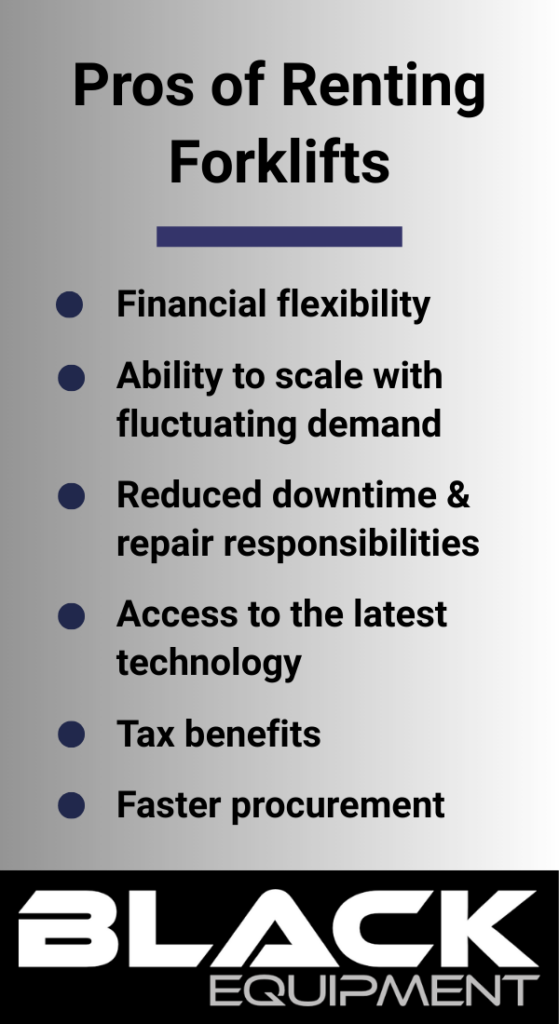
Some advantages of short-term rentals include:
- Scalability of your fleet, with maximum flexibility
- Minimal commitment and costs, allowing you to pay for forklifts only when you will use them
- Fast access to equipment during emergencies or spikes in demand
- The ability to test the latest equipment technology and different forklift types, such as electric vs. ICE or cushion vs. pneumatic, before making a purchase
- Maximizing facility space, as you won’t have unused trucks sitting idle
- No long-term maintenance responsibility or costs, which are typically handled by the rental company
- Increased uptime
Long-term Rentals
Long-term rentals typically are six months or longer in duration and may be structured as multi-year agreements. They are designed to meet businesses’ daily and long-term operational needs and can provide stability and predictability.
Ideal Scenarios
- Warehousing & 3PL: Long-term rentals can support core fleets during long contracts requiring stable and consistent output. When warehouses bid on contracts of varying lengths, securing rentals to match the project term will reduce their financial risk should the job finish early. For example, a 2-year rental will be cheaper than a 3-year lease term and can be returned any time.
- Manufacturing: Meet the demands of long-term contracts with specialized equipment, such as high-capacity forklifts for heavy-load applications or rough-terrain forklifts in mixed indoor/outdoor operations. Long-term rentals can benefit manufacturers looking to fill a prolonged need without the administrative burden. . . no record keeping, tracking of depreciations for taxes, or maintenance and repairs.
- Agriculture: Rent specialized trucks to fulfill year-round operations for grain facilities, feed mills, or large livestock applications. This can also be useful for environments with rough terrain that require forklifts with rugged, pneumatic tires.
Benefits
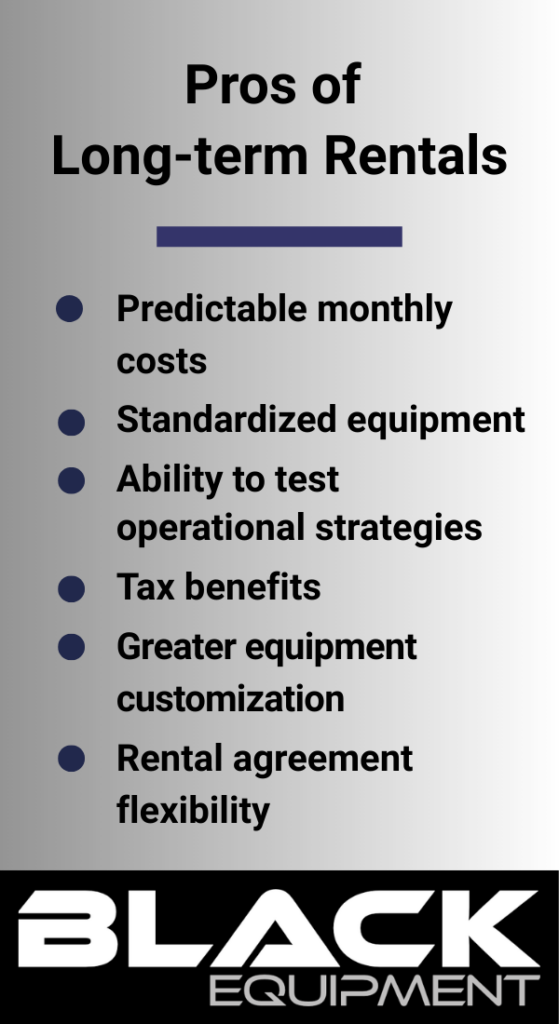
Like short-term agreements, and unlike purchased equipment, long-term rentals will save space in your facility, alleviate the responsibility of maintenance, and allow you to free up cash for other business expenditures. Additional advantages of long-term rentals include:
- Predictable monthly costs, which are typically lower than short-term rental costs and allow for simplified budgeting
- The ability to standardize equipment across multiple facilities
- The ability to test new operational strategies with different equipment, such as experimenting with masted-tuggers and narrow aisles to condense racking
- Fully tax-deductible business expense: while purchased vehicles can be depreciated over multiple years, rental payments can be deducted in full each year they occur
- Greater equipment customization, providing long-term access to the right equipment without ownership burdens
- Rental agreement flexibility, as many dealers provide custom add-ons, such as additional safety lights, and term durations longer than one year
5 Factors That Determine the Right Rental Term
The ideal forklift rental duration will depend on your business’s unique needs.
While there are certain scenarios that intrinsically warrant rentals for specific durations of time, businesses will want to consider a variety of factors to make an informed decision.
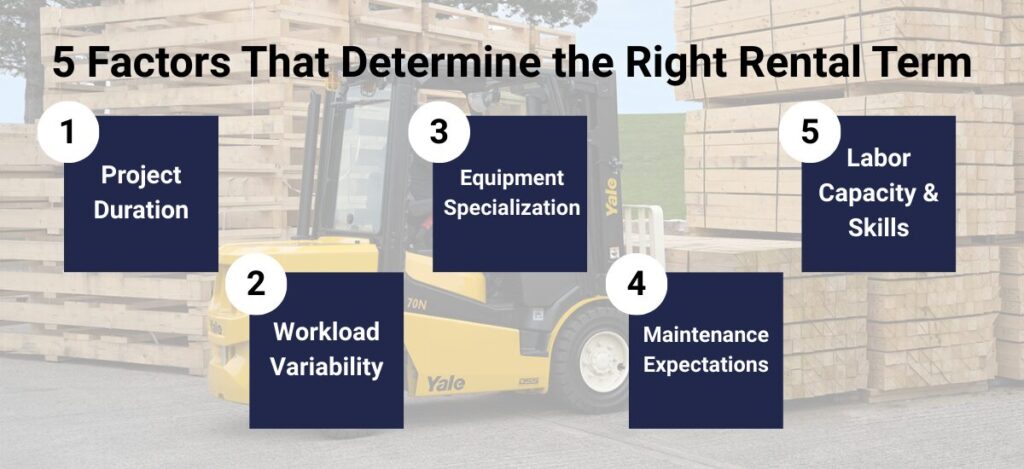
1. Project Duration.
The duration of a new contract or project typically determines the duration of the rental term. When the project duration is unknown, be sure to let your rental specialist know upfront in order to find the right solution.
2. Workload Variability.
Are you expecting steady demand or seasonal demand? Depending on the industry, seasonal trends are often predictable, which would allow you to plan to rent additional trucks for the few busy months. If a business can anticipate growth through an expansion or new product line, consider a long-term rental.
3. Equipment Specialization.
Long-term rentals of high-capacity, narrow aisle, or rough‑terrain units can be useful for long contracts. Short-term rentals are better when you need specialized trucks only on occasion.
4. Maintenance Expectations.
Do you lack an on-staff technician or wish to offload maintenance responsibilities or minimize downtime?
5. Labor Capacity and Skills.
Do you have operators with the capacity and training necessary for the forklifts you are renting? Consider a long-term rental of standardized trucks to eliminate or streamline any need for training.
Cost Considerations: Beyond the Monthly Rate
Undoubtedly, one of the biggest factors driving any business decision is budget. Understanding and predicting all the costs is critical to structuring a beneficial rental agreement.
Where is your money going? Let’s look at how dollars are spent with short-term vs. long-term forklift rentals.
1. Cash Flow Management & Budget Predictability
With short-term rentals, you can match rental costs directly to revenue cycles or project timelines. Long-term rentals can simplify forecasting with predictable fixed payments.
2. Matching Rental Costs to Utilization Rates
As short-term rentals typically have higher monthly payments than long-term rentals, short-term rentals will likely cost you more per day. However, if you only use these trucks occasionally, a short-term rental beats the expenses you’d otherwise pay for trucks sitting idle. If you use trucks almost daily, a long-term rental will be more cost-effective.
3. Maintenance Inclusion and Uptime Guarantees
It’s important to understand whether preventative maintenance and repairs will be included in your rental agreement, as well as if your rental partner will guarantee fast replacement units to eliminate downtime during maintenance. Typically, long-term rentals cover more than short-term rentals. At Black Equipment, we cover maintenance and repair for both short- and long-term rentals. Also, if a rental breaks down, we replace it with a model with similar capabilities.
4. Transportation and Delivery Fees
Short‑term rentals may incur more frequent delivery/pickup charges if equipment is cycled in and out. Long‑term rentals typically reduce transportation frequency, lowering total logistics costs. Black Equipment offers transportation and delivery services in all rental agreements.
5. Hidden Costs of Making the Wrong Rental Plan
Conducting a thorough assessment of your project needs prior to renting can save you unnecessary expenses. Repeated short-term rentals can quickly become more expensive than a single long-term agreement if your need expands unexpectedly. On the other hand, choosing a long-term rental when demand is uncertain can lead to waste if equipment sits idle.
Likewise, you’ll also want to rent the right number of units to meet workload needs. If you rent too few forklifts, missing productivity goals can also cost you.
6. Fleet Standardization and Training Costs
Long‑term rentals can help standardize equipment across facilities, which reduces the costs associated with operator re-training time and errors, parts inventory complexity, and maintenance variability. Short-term rentals may introduce different equipment models, which can provide flexibility to operators, but also increase training needs. Black Equipment offers operator training to help your operators handle the equipment safely and efficiently.
Rental Duration
At Black Equipment, our goal is to provide peace-of-mind to help you thrive. Let’s make it easy: Here are the answers you need about short-term and long-term rentals.
- How long is a short-term forklift rental?
Short-term rentals can be a single day to several months in duration. Specifically, at Black Equipment, a short-term forklift rental can span from one day to six months. - How long is a long-term forklift rental?
Long-term rentals are six months or longer in duration and can be structured as multi-year agreements at Black Equipment. - When should I choose a short-term forklift rental?
Short-term forklift rentals are ideal for meeting temporary needs such as seasonal demand surges or material needs, rapid changes like short production runs, or unexpected operational challenges like equipment breakdowns. - When should I choose a long-term forklift rental?
Long-term forklift rentals are best suited for meeting daily and long-term operational needs, such as long-term contracts, without the responsibility of a purchase. - How should I choose the right forklift rental duration?
Several factors influence whether a short- or long-term forklift rental is right, including your organization’s budget, the project duration, workload variability, type of equipment needed, maintenance expectations, and labor capacity and skills. - Is renting cheaper than buying a forklift?
This primarily depends on a) how consistently the forklift will be used during the rental period and b) the duration of the commitment period. You’ll also want to consider how much you wish to spend per month versus throughout the rental term. You can call Black Equipment, and our highly experienced rental specialists can provide guidance to help you make an informed decision. - Can I switch from a short-term to a long-term rental?
Yes, just CONTACT Black Equipment’s team of experts. - What maintenance is included in forklift rental?
Black Equipment covers preventative maintenance and repair except in cases of damage or abuse.
Final Thoughts: How Black Equipment Supports Short-term and Long-term Forklift Rental Strategies
The right rental duration depends on your organization’s workload, environment, and operational goals.
If you still can’t decide between a short-term rental or long-term rental for your fleet, the seasoned experts at Black Equipment can help you assess your requirements and provide recommendations.
We provide both short-term and long-term rental agreements to meet companies’ unique rental needs . Black Equipment offers rental terms spanning from days to weeks, month to month, and 3, 6, 9, and 12 month terms. With over 1,500 rental units in our growing fleet, our experts are ready to work closely with manufacturers, warehousers and other industries to deliver quality rental solutions.
OR
Click for your local branch