
Optimizing Your Forklift Fleet: Rental Strategies for Peak Performance
Intro
For any material handling manager, a high-performing forklift fleet is an essential asset. As fleet managers in warehousing, manufacturing, agriculture, and ports/terminals all face productivity demands, a fully optimized forklift fleet can help see you through challenging or unpredictable seasons.
Whether you’re looking to supplement your owned forklifts or acquire one specialty forklift, renting a forklift is an increasingly popular option that provides financial flexibility, predictable costs, and fast access to equipment. In this guide, we’ll help you learn the pros and cons of renting forklifts, when to rent a forklift, and key rental strategies to optimize your fleet.
How to Optimize Your Forklift Fleet
Assessing the performance and efficiency of your fleet is a great place to start. Fleet managers can ask themselves the following critical questions:
- Is my fleet sized properly? High performing fleets are sized to utilization rates, with enough trucks to maximize capacity and few trucks sitting idle.
- Are all trucks capable of achieving similar levels of performance? All trucks in your fleet should offer operators standardized efficiency and safety, with the latest technology.
- Is your fleet providing reliable uptime? An optimized fleet is supported by proactive maintenance with minimal downtime.
- Does your fleet make financial sense for your business? Are any trucks accounting for an unreasonable percentage of expenses? The goal is to scale quickly without over-investing.
Renting as a Strategic Tool in Fleet Optimization
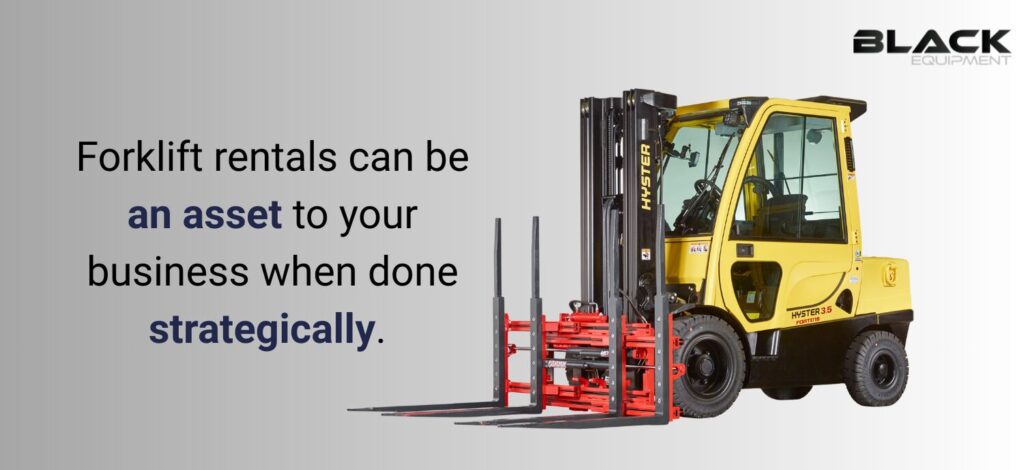
Forklift rentals can be an asset to your fleet optimization when done strategically. When deciding whether to rent new equipment, companies will need to weigh numerous factors, such as operational goals, usage rates, budget, and expected costs.
Understanding the benefits and drawbacks of renting can help companies determine whether the procurement strategy will align with their goals.
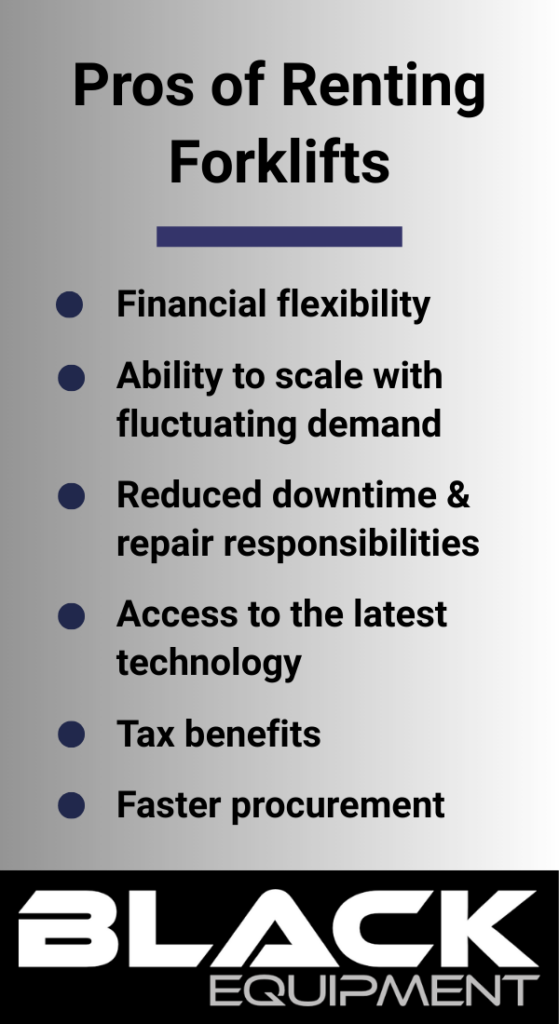
Pros of Renting
Here’s a closer look at the benefits of leveraging strategic rental agreements.
- Financial flexibility: Eliminate the need for initial capital investment, ongoing maintenance and extra storage space for unused equipment. Renters will have manageable and fixed monthly payments.
- Ability to scale with fluctuating demand: Industries that experience significant changes in demand, such as warehousing and third-party logistics (3PL), can leverage rental forklifts to fulfill short-term or seasonal needs without making long-term commitments.
- Reduced downtime and repair responsibilities: Companies can rent forklifts during planned maintenance intervals to keep operations running even when equipment is down. Rental companies that include delivery and pickup in their rental costs can further reduce costs and increase uptime by eliminating the need for travel.
- Access to the latest technology and safety features: Rental forklifts are often equipped with emerging technologies like telematics, ergonomics, automation, and safety features. This also gives companies the chance to try different forklift models before buying.
- Tax benefits: While owning vehicles can offer interest deductions and depreciation, rental payments are fully deductible business expenses.
- Faster procurement: No need to wait for production lead times. Most rental equipment is typically readily available when you need it, if not high in demand.
Cons of Renting
Here are a few drawbacks of renting to consider.
- Long-term cost considerations: Rentals are most cost-effective in the short term. If you will use the equipment daily and need it for a long period of time, consider buying instead.
- Availability constraints: If you hope to rent a specialty forklift or rent during peak seasons, be sure to schedule your rental well in advance.
- Limited customization: Rental companies impose limitations on how customers can use or customize their forklifts, which could make it more difficult for renters to integrate the lift into their typical workflow.
Don’t overlook the importance of finding a strong rental partner. Choose a rental vendor providing full-service operations , encompassing on-site maintenance, rapid repairs, and available backup units. Black Equipment rentals include the cost of preventative maintenance and repair and delivery & pickup service, further minimizing downtime and overhead.
When Renting Makes the Most Sense
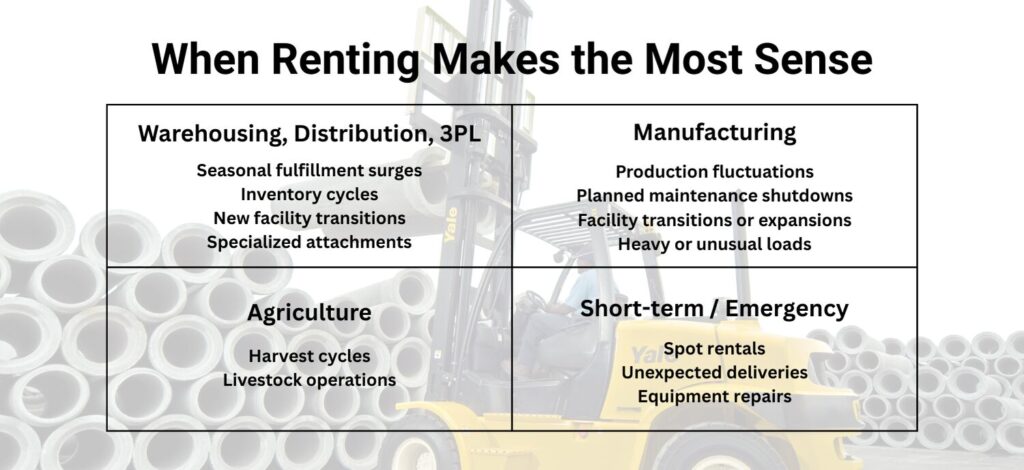
While forklift rentals are advantageous over purchases in many scenarios, they can be costly in others. Here are several scenarios, organized by industry, where rentals can help optimize your forklift fleet.
Warehousing , Distribution, and 3PL
- Seasonal fulfillment surges, such as the holiday season, new product releases, or when onboarding a new client
- Inventory cycles or audits
- New facility transitions when companies temporarily operate in two buildings
- Specialized attachments for new product categories
Manufacturing
- Production fluctuations
- Planned maintenance shutdowns, when manufacturers need to move machinery, tools, or materials
- Facility transitions or expansions
- Heavy or unusual loads — such as deliveries shipped in oversized pallets or new machine installations — requiring specialized equipment
Agriculture
- Harvest cycles, such as planting or harvest seasons
- Livestock operations, to meet intermittent maintenance needs such as bedding, fence construction, or feed delivery
Short-Term and Emergency Needs
- Spot rentals
- Unexpected deliveries
- Equipment repairs requiring temporary replacements
Key Rental Strategies for Peak Performance
Now that you know some specific scenarios where rentals would be most beneficial, let’s take a closer look at several specific rental strategies for optimizing forklift fleets.
Warehousing, Distribution, and 3PL
Keep Up with Demand Spikes
Strategy: Rent additional units for e-commerce-driven order surges, ensuring a scalable handling of packaged goods while controlling operational costs.
Pro tip: Focus on Rentals with quick-swap batteries to support multi-shift operations in distribution centers.
Minimize Downtime from Charging
Strategy: Incorporate rental forklifts with fast-charging energy platforms and redundant units during high-volume periods or three-shift operations. This allows you to maintain uninterrupted operations, optimizing fleet scalability and downtime charging.
Pro tip: Integrate smart warehouse scheduling tools with rentals to predict and buffer against delivery delays.
Test New Warehouse Routes
Strategy: Optimize layout and minimize travel distances by renting versatile forklifts for testing new warehouse configurations, to enhance overall fleet productivity.
Pro tip: Incorporate telematics in rentals to gather data for ongoing route refinements and congestion avoidance.
Light Manufacturing
Increase Fleet Efficiency
Strategy: Right-size your fleet by renting additional units based on data-driven assessments of workload and capabilities. This can help maximize productivity, without over-investing in underutilized owned equipment.
Pro tip: Use telematics data from rented forklifts to refine picking routes to further reduce travel times and fuel waste.
Rent for Increased Production
Strategy: Reduce costs associated with standby equipment. Establish a hybrid model by owning the right amount of core forklifts for regular operations and renting extras for variable production runs.
Pro tip: Measure output by cases moved to justify rental periods and achieve cost-per-pallet efficiencies.
Heavy Manufacturing
Plan for Shutdowns
Strategy: Rent heavy-duty forklifts to supplement core fleet during maintenance shutdowns to maintain production flow for large-scale material handling.
Pro tip: Select high-capacity rentals with specialized attachments to match the demands of metal fabrication or assembly lines, such as navigating awkward loads through confined areas.
Support Aging Fleets
Strategy: Access modern, high-efficiency rentals to supplement your aging owned fleet. This can improve energy use and reducing maintenance downtime in continuous operations.
Pro tip: Partner with dealers for solutions-focused rentals that include fleet assessments for long-term optimization.
Agriculture
Prepare for the Harvest
Strategy: Utilize short-term forklift rentals during peak harvest seasons to handle increased material handling demands. This allows you to ensure efficient movement of crops and equipment, without committing to permanent fleet expansion.
Pro tip: Opt for rentals with all-terrain capabilities to effectively navigate uneven farm terrain.
Emergency Response Rentals
Strategy: Procure rentals for emergency replacements during equipment breakdowns to maintain crop handling timelines in time-sensitive farming operations.
Pro tip: Build relationships with local rental providers for rapid deployment and customized agricultural adaptations.
Lumber & Metals
Keep Up with High Demand Cycles
Strategy: Use rental forklifts for temporary fleet buffering in high-demand cycles, such as lumber processing peaks.
Pro tip: Rent models with extended forks or clamps designed for irregular loads to improve safety and speed.
Specialty lifts for Special Projects
Strategy: Rent specialized heavy-lift models for project-based needs, like metal stock replenishment, to avoid over-sizing the permanent fleet.
Pro tip: Monitor peak hour demands to schedule rentals precisely, preventing bottlenecks in material flow.
Chemicals, Plastics, & Pharmaceuticals
Offload Compliance Burdens
Strategy: Rent LPS-rated forklifts from a full-service provider to handle materials in areas with flammable solvents or dust. The maintenance and safety inspections included in the rental agreement can offload compliance burdens while optimizing fleet costs.
Pro tip: Partner with vendors who offer customized service plans.
Common Forklift Rental Pitfalls to Avoid
When preparing a fleet rental strategy, companies need to do more than construct an effective plan — they need to research. If you fail to “do your homework” before renting, you may end up with a truck ill-suited for the job and waste time and money.
Here are 5 common mistakes fleet managers should avoid when renting .
1. Renting Without Assessing Utilization.
How often do you have owned forklifts sitting idle? How often will you use the rental forklifts? At Black Equipment[GR1] , our experts consult with all prospective customers to assess their requirements and recommend ideal solutions before every rental, lease or sale.
2. Choosing the Wrong Equipment.
From lift capacity to reach, do you know the proper equipment specifications needed to handle your needs? The experts at Black Equipment can help you assess your needs and find the best rental solution.
3. Overlooking Operator Training Needs.
You can rent the ideal forklift, but it will be worthless if you don’t have an operator trained to safely drive one. Make sure you have operators trained to drive the rental forklifts, or the ability to train them.
4. Forgetting Attachments.
As rental forklifts typically cannot be modified with specialized configurations or attachments, you should ensure you’re renting equipment with the proper attachment , or rent the attachment itself.
5. Scheduling Your Rental Last Minute.
If you need a specific rental for a specific time, requesting your rental in advance can ensure the truck is available for your needs.
Renting Forklift Attachments
The right attachment can improve your forklift’s efficiency, help outfit your forklift for special applications, and open your company up to new business.
At Black Equipment, we offer a wide array of forklift attachment rentals to adapt your forklift rental to almost any application. Our rental attachments include, but are not limited to:
- Rotators for dumping containers and manipulating loads
- Clamps that regulate pressure on sensitive products
- Round, rectangular, and square bales for the paper manufacturing industry
- Hay spear attachments, fork extensions, and cotton clamps for the agriculture industry
Choosing the Right Acquisition Strategy: Rent, Lease, or Buy
Buy or rent, how you procure your equipment has a significant impact on your financial and operational bottom line. However, there is one more acquisition strategy to consider: leasing.
Like with renting, leasing a vehicle offers companies quick access to forklifts with the latest technologies with low upfront costs. However, leasing provides companies with access to the equipment for longer periods of time than short-term rentals. Capital leases, which are treated as debt-financed purchases, also provide the lessee with the ability to purchase the equipment at the end of the lease term.
Those looking for longer-term commitments should keep in mind that leasing does come with some drawbacks, including hidden fees and maintenance costs and less flexibility. Additionally, while short-term rentals often have higher monthly payments, their total cost is typically lower than leasing for brief usage periods due to fewer additional fees.
Final Thoughts: Achieve Flexibility and Optimize Efficiency with Rentals
Renting forklifts can be an effective and flexible solution to meet your company’s changing, seasonal, or growth needs.
If you still can’t determine if renting will benefit your fleet, the seasoned experts at Black Equipment can provide guidance to help you make an informed decision.
The Black Equipment team works closely with manufacturers and customers to offer high-quality solutions. Our rental agreements include preventative maintenance and repair (except in cases of abuse) and delivery & pickup, and flexible rental terms, and cover over 1,500 rental units in our growing rental fleet.
OR
Click for your local branch